

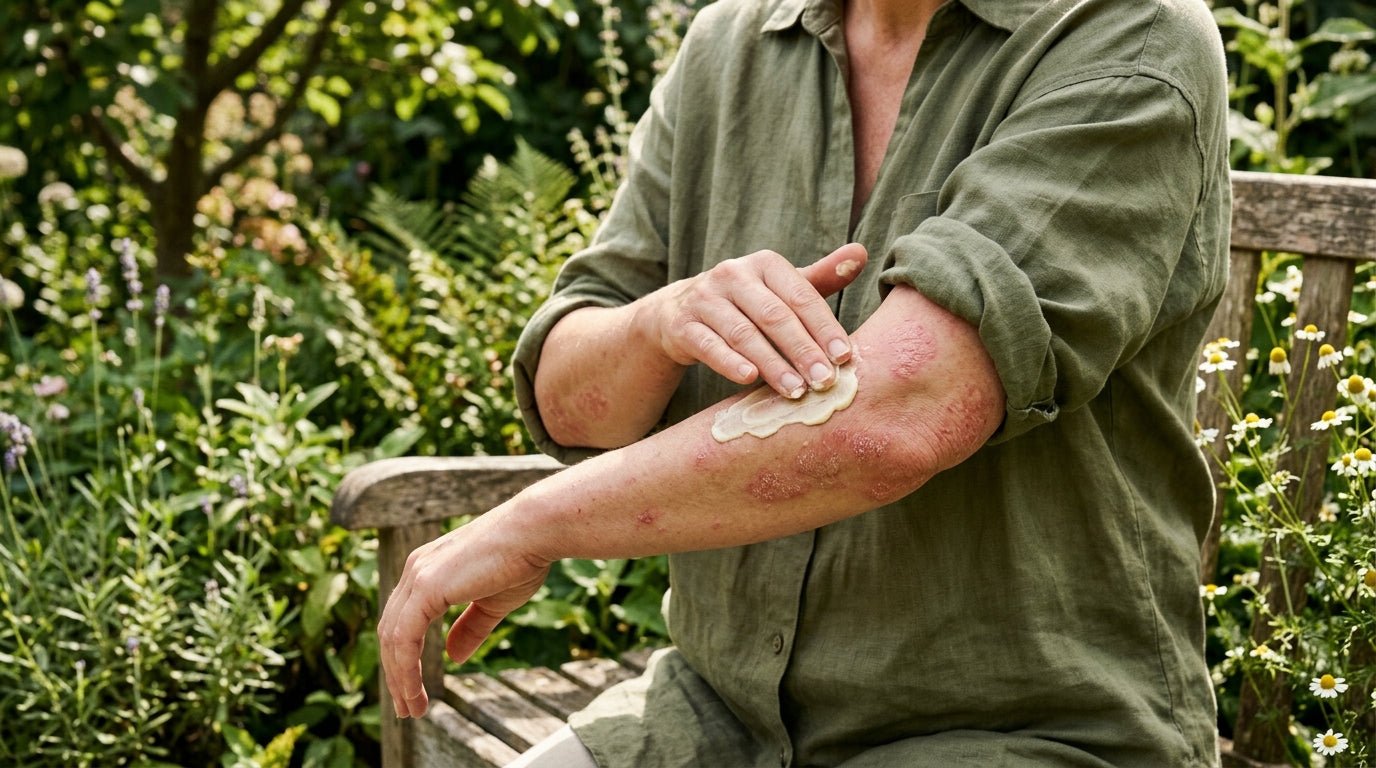
Best Botanical Creams for Psoriasis Fast Itch Relief
Pruritus, the medical term for the intense, relentless itch that accompanies psoriasis, is often described by patients as the single most debilitating symptom of the condition. It is a deep-seated, burning sensation that disrupts sleep, heightens daily stress, and drives a vicious cycle of scratching that only damages the skin further.
Historically, the primary intervention for this severe itch has been strong topical corticosteroids. However, in 2026, the landscape of topical dermatological care is shifting dramatically. Due to growing concerns over side effects like skin thinning, tachyphylaxis, and Topical Steroid Withdrawal (TSW), both dermatologists and patients are increasingly embracing botanical skincare and wellness formulations. Guided by advances in green chemistry, modern steroid-free creams are demonstrating that natural, plant-based science can match the therapeutic demands of chronic skin conditions. This comprehensive guide explores which botanical extracts are most effective, how steroid-free creams compare in timing to steroid options, and which natural ingredients you should avoid to prevent further irritation.
The Power of the Plants: Which Botanical Extracts Are Most Effective for Psoriasis Itch Relief?
To effectively quiet a psoriatic itch, a topical cream must perform a dual role: it must physically soothe the nerve endings at the surface while simultaneously dampening the localized inflammatory cytokine cascade. Several top-rated natural botanical ingredients have established themselves as highly effective in achieving this:
- Mahonia aquifolium (Oregon Grape): Native to western North America, Oregon grape root has been a staple of traditional herbal medicine for centuries. Its therapeutic efficacy is driven by its high concentration of berberine, a powerful isoquinoline alkaloid. Berberine has remarkable anti-proliferative properties, meaning it helps slow down the overactive division of skin cells that causes thick, scaly plaques to build up. By minimizing this cell accumulation, it directly reduces the structural pressure and tension that fuels the itch.
- Indigo naturalis (Qing Dai): This deep blue powder, traditionally extracted from plants such as Baphicacanthus cusia, has become one of the most exciting botanical extracts in modern dermatology. Its primary active component, indirubin, works to regulate the growth and maturation of keratinocytes. More importantly, Indigo naturalis has been shown to down-regulate the interleukin-17 (IL-17) pathway, which is one of the chief immune pathways responsible for psoriasis flares, redness, and neuropathic itching.
- Aloe vera (Aloe barbadensis): While aloe is famous for comforting sunburns, its benefit in chronic plaque psoriasis is profound. The gel is packed with complex polysaccharides, salicylic acid, and antioxidants that work together to restore a deeply compromised moisture barrier. By acting as a nutrient-dense emollient, it hydrates dry scales and delivers an immediate, cooling distraction to localized nerve endings.
- Colloidal Oatmeal: Rich in avenanthramides (a unique group of antioxidant and anti-inflammatory compounds), colloidal oatmeal forms a protective physical barrier over damaged skin. It locks in crucial lipids, prevents trans-epidermal water loss, and shields compromised plaques from external irritants.
Clinical Evidence Supporting Botanical Psoriasis Creams
The modern shift toward botanical skincare is not merely a trend driven by anecdotal evidence; it is backed by clinical research. Dermatologists and research institutions have subjected these plant extracts to rigorous clinical trials to evaluate their objective safety and efficacy.
For example, a comprehensive PMC systematic review on Mahonia aquifolium analyzed multiple clinical trials assessing this botanical. The review concluded that in five out of seven trials, topical Mahonia aquifolium led to a statistically significant improvement in overall psoriasis symptoms, showing a marked reduction in scaling and redness with minimal local side effects.
Furthermore, Indigo naturalis has demonstrated remarkable results in controlled environments. In a randomized controlled trial published in PMC, researchers evaluated Indigo naturalis ointment as a topical monotherapy for patients with moderate plaque psoriasis. By week eight, 56.3% of the patients using the indigo ointment achieved a PASI 75 (representing a 75% or greater improvement in the Psoriasis Area and Severity Index score), compared to a 0% response in the placebo group. Biopsies of the treated skin confirmed that the botanical extract successfully normalized genetic expressions, down-regulating the overactive IL-17 inflammatory pathway. A separate systematic review published in PMC further confirmed that the active constituents in Indigo naturalis can regulate cellular pathways to restore epidermal balance safely.
Steroid-Free vs. Steroid Creams: Comparing Itch Relief Timing
When you are in the midst of a painful, burning psoriasis flare-up, the speed of relief is your highest priority. To find the best natural psoriasis cream fast itch relief options, it is important to understand how steroid-free creams compare to traditional steroid creams in terms of timing and long-term utility.
Topical Steroid Creams (Corticosteroids)
These are the most frequently prescribed conventional treatments for mild to moderate psoriasis. They function by aggressively suppressing the localized immune response and shutting down inflammation. Consequently, they offer exceptionally fast itch relief, with patients often feeling a dramatic reduction in pruritus within hours or days. Visually, plaques can begin to flatten and clear within two to four weeks.
However, because of their systemic potency, topical steroids are restricted to short-term cycles, typically up to three weeks. Prolonged use carries risks of skin atrophy (thinning), easy bruising, spider veins, and rebound flares that can leave the skin in a worse state than before.
Botanical Steroid-Free Creams
Steroid-free botanical creams operate on a dual-phase timeline that is fundamentally different from synthetic alternatives:
- Immediate Phase (Minutes to Hours): High-quality botanical creams formulated with cooling agents like menthol, camphor, aloe vera, and colloidal oatmeal soothe sensory nerves instantly. By stimulating the cold-sensitive receptors on the skin, they override the pain and itch signals sent to the brain, providing immediate, fast itch relief.
- Therapeutic Phase (4 to 8 Weeks): The active anti-inflammatory and cell-regulating botanical extracts, such as Oregon grape and Indigo naturalis, require consistent, daily application to show their structural benefits. Instead of abruptly freezing the immune response, they gently modulate cellular pathways, rebuild the lipid barrier, and reduce plaque thickness over a four-to-eight-week period.
While the structural plaque-clearing phase takes longer than a strong steroid, botanical creams do not cause skin thinning or chemical dependency. This makes them highly safe for unlimited daily application and ideal for preventative, long-term maintenance.
| Comparison Feature | Topical Steroid Creams | Botanical Steroid-Free Creams |
|---|---|---|
| Primary Active Agents | Synthetic Corticosteroids (e.g., Hydrocortisone, Triamcinolone, Clobetasol) | Plant Extracts (e.g., Mahonia aquifolium, Indigo naturalis, Aloe vera, Colloidal Oat) |
| Immediate Itch Relief | Very fast (typically hours to a few days) through aggressive immune suppression | Instant sensory relief (minutes) via cooling agents; progressive structural relief over weeks |
| Plaque Clearing Speed | Rapid visible improvement (typically 2 to 4 weeks) | Gradual, sustainable clearing (typically 4 to 8 weeks) |
| Long-Term Safety Profile | High risk of skin thinning, easy bruising, spider veins, and rebound flares | Excellent long-term safety profile; no risk of skin atrophy or rebound symptoms |
| Usage Duration Limits | Strictly limited (usually up to 3 weeks maximum per cycle) | Safe for unlimited daily application and preventative maintenance |
Natural Psoriasis Cream Ingredients to Avoid: Steer Clear of These Irritants
When selecting a natural, steroid-free cream, it is crucial to recognize that the label "natural" does not automatically mean a product is safe or gentle. Compromised psoriatic skin has a broken moisture barrier, making it highly susceptible to contact dermatitis and secondary irritation. To prevent accidental flare-ups, you should actively avoid several common natural ingredients:
- Highly Concentrated Essential Oils: Volatile plant oils such as undiluted tea tree, lavender, eucalyptus, or peppermint oils are rich in natural chemical compounds that can act as potent allergens. On a broken skin barrier, they frequently cause immediate burning, localized redness, and increased itching.
- Drying Alcohols: Lightweight creams often use simple alcohols (such as alcohol denat, isopropyl alcohol, or ethanol) as solvents to ensure a fast-drying feel. However, these alcohols strip the skin of its natural lipids, causing rapid drying of plaques, worsening scales, and triggering the itch-scratch cycle. Seek out nourishing, fatty alcohols like cetearyl or stearyl alcohol instead.
- Synthetic Fragrances and Hidden Preservatives: Many products marketed as "botanical" still contain synthetic fragrances (often labeled as "parfum") to mask strong herbal odors. Fragrances are a leading cause of skin sensitization. Additionally, watch out for harsh preservatives like parabens or formaldehyde-releasing agents, which can provoke contact dermatitis in sensitive individuals.
- Unrefined Coal Tar: Although coal tar is a classic over-the-counter option that slows skin cell growth, crude or unrefined coal tar has an unpleasant, strong odor, stains clothing, and can cause severe skin irritation, burning, and extreme photosensitivity. Modern, refined botanical extracts offer a far more elegant and gentle alternative.
How to Choose the Best Natural Psoriasis Cream for Fast Itch Relief
Finding a top-rated steroid-free psoriasis cream with natural botanical ingredients requires looking for a balanced formulation. The best creams do not rely on a single miracle ingredient; they leverage a synergistic blend of rapid-acting cooling agents and deep-acting cellular healers.
Begin by selecting a cream with a rich emollient base. Lipids such as jojoba oil, shea butter, and ceramides imitate the skin's natural lipid structure, locking in moisture and smoothing down scales to protect the underlying layers from mechanical irritation. Next, verify that the cream features clinically-backed botanical actives like Mahonia aquifolium or Indigo naturalis at therapeutic concentrations to address the root causes of the plaques over time. Finally, ensure the presence of gentle sensory calmers, such as colloidal oatmeal or aloe vera, to deliver the fast itch relief you need to break the itch-scratch cycle. This multi-layered approach ensures your skin is instantly comforted while being structurally rebuilt for long-term health.
Frequently Asked Questions
Which botanical extracts are most effective for psoriasis itch relief?
The most clinically supported botanical extracts for relieving psoriasis itch and reducing plaque severity are Mahonia aquifolium (Oregon grape) and Indigo naturalis (Qing Dai). Mahonia aquifolium contains the alkaloid berberine, which helps slow down rapid skin cell growth and reduce localized inflammation. Indigo naturalis contains active compounds like indirubin, which directly down-regulate the inflammatory IL-17 pathway. Additionally, Aloe vera and colloidal oatmeal are highly effective for their immediate cooling, soothing, and skin-barrier-repairing properties.
How do steroid-free creams compare to steroid creams for itch relief timing?
Topical steroid creams suppress the immune response aggressively, offering rapid relief from itching within hours and flattening plaques within two to four weeks, but they carry risks of skin thinning and rebound flares. Steroid-free botanical creams operate on a dual timeline: they provide immediate sensory cooling within minutes using ingredients like aloe and menthol, while their active anti-inflammatory botanicals (like Mahonia and Indigo) work over four to eight weeks to structurally heal the skin barrier. This slower, structural approach is completely safe for long-term daily maintenance.
What natural psoriasis cream ingredients should I avoid to prevent irritation?
You should avoid highly concentrated or volatile essential oils (such as tea tree, lavender, and citrus oils) because they can act as potent contact allergens on broken skin. Additionally, steer clear of drying alcohols (like denatured or isopropyl alcohol) which strip essential moisture, as well as synthetic fragrances, parabens, and crude, unrefined coal tar which can trigger severe burning, irritation, and photosensitivity.
Is there strong clinical evidence supporting botanical psoriasis creams?
Yes, a substantial body of dermatological research supports the use of botanical creams. Multiple clinical trials, including randomized, double-blind, placebo-controlled studies, have demonstrated that both Mahonia aquifolium and Indigo naturalis significantly reduce the severity of plaques, scaling, and pruritus. Biopsies from these trials have objectively shown that these botanical extracts work at a cellular level, successfully normalizing cell differentiation and down-regulating key inflammatory cytokines.
Disclaimer: This article is for general informational and educational purposes only and does not constitute professional medical, financial, or legal advice. Always consult a qualified professional before making decisions about your health, finances, or legal situation. The information here may not reflect the most recent developments and is provided without any warranty of accuracy or completeness.
Read more
The gentle rustle of oat fields, the scientifically precise ratio of essential skin lipids, and the quiet relief of an irritation-free morning. For millions of individuals living with atopic dermat...
Topical Steroid Withdrawal (TSW), which is also known as Red Skin Syndrome or Topical Steroid Addiction, is a challenging iatrogenic condition that can develop after discontinuing prolonged, freque...