

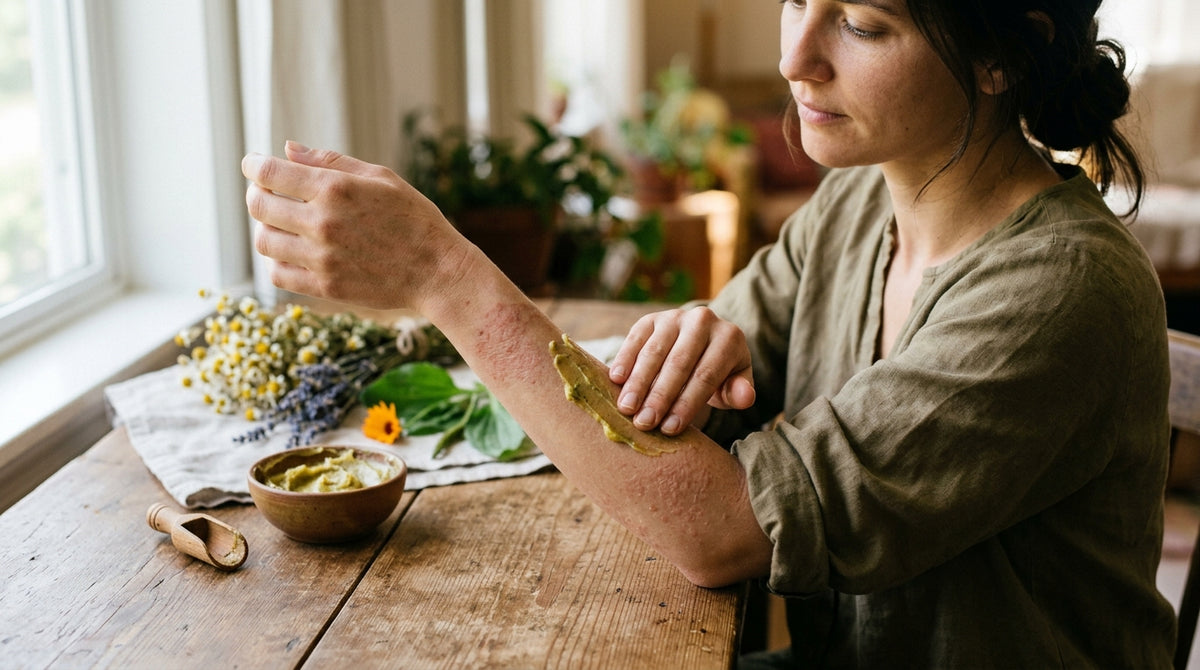
CAM Botanicals for Eczema: Topical Guidelines & Evidence
Living with atopic dermatitis often feels like navigating an unpredictable cycle of intense itching, inflamed flares, and compromised skin barrier function. For decades, conventional management centered almost entirely on reactive strategies: applying topical corticosteroids during a flare and relying on petrolatum-based ointments between episodes. Today, the conversation around skin health has evolved significantly.
Patients, caregivers, and clinicians are increasingly interested in the therapeutic potential of botanical ingredients and integrative skin wellness. Driven by concerns over potential side effects from long-term steroid use as well as a desire for holistic daily management, more than 50% of individuals with eczema explore complementary health strategies.
However, the natural skincare realm is often crowded with unsupported marketing claims, unstandardized extracts, and potent essential oils that can irritate hypersensitive skin. To help consumers distinguish between genuinely therapeutic botanicals and potential irritants, organizations such as the National Eczema Association (NEA) and dermatological bodies have evaluated complementary and alternative medicine (CAM) approaches. Understanding the clinical evidence, safety profiles, and official guidelines behind botanical topicals is essential for building a safe, soothing, and barrier-supportive skincare routine.
Understanding Complementary and Alternative Medicine in Eczema Care
To evaluate botanical topicals responsibly, it is important to clarify terminology. The National Center for Complementary and Integrative Health (NCCIH) distinguishes between "alternative" and "complementary" approaches based on how they are utilized:
- Alternative Medicine: Practices and interventions used in place of conventional Western medical care.
- Complementary Medicine: Non-mainstream practices and natural formulations used alongside conventional medical treatments.
- Integrative Dermatology: A collaborative discipline that blends evidence-based complementary therapies with standard pharmacological treatments to care for the whole person.
In the context of atopic dermatitis, medical consensus firmly advises an integrative or complementary approach rather than a purely alternative one. Atopic dermatitis is a complex, chronic inflammatory disorder driven by immune dysregulation, epidermal barrier mutations (such as loss-of-function variations in the filaggrin gene), and microbiome dysbiosis.
During acute, severe inflammatory flares, conventional pharmaceutical interventions such as topical calcineurin inhibitors, PDE4 inhibitors, or short courses of topical corticosteroids are often clinically necessary to quickly interrupt the inflammatory cascade. However, during maintenance phases and mild flares, evidence-based botanical topicals can serve as powerful complementary agents. They help rebuild the stratum corneum, restore essential lipids, reduce trans-epidermal water loss (TEWL), and calm low-grade cutaneous inflammation.
What Clinical Guidelines and the National Eczema Association Say
Clinical guidelines from major dermatological bodies, including the American Academy of Dermatology clinical guidelines, emphasize the cornerstone role of barrier maintenance. While guidelines remain cautious regarding unregulated oral supplements or unstandardized herbal decoctions, they consistently affirm the therapeutic value of specific topically applied plant lipids and natural anti-inflammatory compounds.
The National Eczema Association plays a pivotal role in guiding consumers through its Seal of Acceptance program. To receive this recognition, products undergo rigorous laboratory and clinical testing by an independent panel of dermatologists and toxicologists. The formulation must demonstrate that it is free from known irritants, harsh chemical preservatives, added fragrances, and notorious plant-derived sensitizers listed on the NEA Ecz-clusion List.
According to NEA literature and integrative dermatologists, incorporating botanicals should always be guided by clinical data rather than internet trends. An effective botanical topical must accomplish three fundamental goals:
- Replenish Missing Lipids: Deliver physiological ratios of free fatty acids to reinforce intercellular lipid layers.
- Downregulate Pruritus and Inflammation: Provide bioactive phytochemicals capable of calming itching and cytokine release without thinning the skin.
- Balance the Cutaneous Microbiome: Inhibit opportunistic colonization by Staphylococcus aureus without disrupting beneficial commensal microflora.
Evidence-Backed Botanical Topicals: What Works and Why
Extensive pharmacological and clinical research, including scientific reviews published in PubMed Central, highlights several plant-derived ingredients that consistently demonstrate measurable efficacy in managing atopic dermatitis symptoms.
Colloidal Oatmeal (Avena sativa)
Colloidal oatmeal is one of the most thoroughly researched botanical ingredients in dermatology and holds an official monograph from the FDA as an over-the-counter skin protectant. It is milled from whole oat grains and contains a complex mixture of lipids, beta-glucans, and unique polyphenolic antioxidants called avenanthramides.
Avenanthramides actively inhibit the release of pro-inflammatory cytokines (such as IL-8) and reduce neurogenic itch. Meanwhile, oat beta-glucans act as powerful humectants that bind water to the epidermis. Clinical studies confirm that colloidal oatmeal formulations significantly improve skin hydration, reduce eczema severity scores, and restore a healthy cutaneous pH.
Virgin Coconut Oil (Cocos nucifera)
Virgin, cold-pressed coconut oil is composed of roughly 50% lauric acid, a medium-chain fatty acid renowned for its antimicrobial properties. In atopic dermatitis, skin colonization by Staphylococcus aureus exceeds 70% to 90%, triggering chronic inflammation and disrupting healing.
Clinical trials evaluating topical virgin coconut oil demonstrated that it significantly decreased S. aureus colonization on atopic skin while outperforming standard mineral oil in reducing TEWL and improving skin capacitance. For optimal results, clinical guidelines emphasize using pure, virgin, unrefined coconut oil free of added perfumes or processing solvents.
Sunflower Seed Oil (Helianthus annuus)
Sunflower seed oil is an exceptional plant oil for atopic skin due to its exceptionally high concentration of linoleic acid, an essential omega-6 fatty acid. Linoleic acid serves as a fundamental building block for skin ceramides, the crucial mortar that holds the stratum corneum together.
When applied topically, sunflower seed oil activates Peroxisome Proliferator-Activated Receptor-Alpha (PPAR-alpha). This biological pathway accelerates epidermal barrier recovery, stimulates native ceramide production, and rapidly decreases cutaneous inflammation.
Licorice Root Extract (Glycyrrhiza glabra)
Licorice root contains active triterpenoids, notably glycyrrhizin and glabridin, which exhibit potent anti-inflammatory properties. These phytochemicals inhibit local cortisol degradation and modulate arachidonic acid cascades, delivering a soothing action that helps calm erythema and burning sensations without the atrophy risks associated with prolonged steroid use.
| Botanical Ingredient | Primary Active Compounds | Dermatological Mechanism | Clinical Consensus |
|---|---|---|---|
| Colloidal Oatmeal (*Avena sativa*) | Avenanthramides, beta-glucans, starches | Anti-pruritic, anti-inflammatory, hygroscopic humectant | Strong Evidence (FDA Monographed) |
| Virgin Coconut Oil (*Cocos nucifera*) | Lauric acid, medium-chain triglycerides | Antimicrobial against *S. aureus*, emollient seal | Moderate to Strong Evidence |
| Sunflower Seed Oil (*Helianthus annuus*) | Linoleic acid (omega-6), vitamin E | PPAR-alpha agonist, boosts endogenously synthesized ceramides | Moderate to Strong Evidence |
| Licorice Root (*Glycyrrhiza glabra*) | Glabridin, glycyrrhizic acid | Inhibits inflammatory prostaglandins, calms redness | Moderate Evidence |
| Olive Oil (*Olea europaea*) | Oleic acid, squalene | Disrupts lipid lamination, provokes mild erythema | Not Recommended (Avoid Topically) |
Botanicals to Approach with Caution (or Avoid Entirely)
A central message from both the National Eczema Association and board-certified dermatologists is that not all natural plant oils support skin barrier repair. In fact, certain popular botanical staples can cause significant harm to atopic skin.
Olive Oil
Despite its celebrated role in culinary wellness, dermatologists strongly recommend against applying olive oil to atopic skin. Olive oil contains a high ratio of oleic acid to linoleic acid. Unlike linoleic acid, oleic acid disrupts the delicate arrangement of intercellular lipids within the stratum corneum. Clinical trials have revealed that topical olive oil causes visible redness, disrupts barrier integrity, and increases trans-epidermal water loss in individuals with sensitive and eczematous skin.
Undiluted Essential Oils
Tea tree oil, lavender oil, peppermint oil, and citrus peels contain volatile monoterpenes and aromatic esters. While these compounds carry therapeutic reputations in traditional aromatherapy, they represent leading causes of allergic contact dermatitis (ACD). Because the atopic skin barrier is highly permeable, volatile compounds easily penetrate the dermal layers, provoking T-cell mediated sensitization that triggers severe contact eczema flares.
Best Practices for Safely Integrating Botanicals
If you decide to incorporate botanical skincare into an atopic dermatitis regimen, following structured dermatological protocols protects your skin from accidental flares:
- Perform a 48 to 72 Hour Patch Test: Before applying any new botanical balm or cream across large areas, apply a small dime-sized amount to the inner arm or wrist twice daily for three consecutive days. Monitor closely for swelling, itching, or tiny red bumps.
- Practice the Soak-and-Seal Technique: Plant oils deliver superior benefits when locked over existing hydration. Bathe in lukewarm water for 10 to 15 minutes, pat the skin gently with a clean towel leaving it slightly damp, and apply your botanical barrier formulation within three minutes to seal in critical water.
- Choose Standardized Formulations: Avoid raw, unrefined culinary mixes or kitchen recipes that lack adequate preservation. Select professionally formulated, pH-balanced skincare products tested against heavy metals, microbes, and common irritants.
- Maintain Transparent Communication: Always inform your dermatologist or healthcare provider about any natural remedies, botanical balms, or dietary modifications you introduce into your routine. This collaborative approach prevents adverse ingredient interactions and ensures acute flares receive prompt, evidence-based care.
Frequently Asked Questions
Can botanical topicals completely replace prescription eczema treatments?
No, botanical topicals are not designed to completely replace prescription medications, particularly during moderate to severe inflammatory flares. While therapeutic botanicals like colloidal oatmeal and sunflower seed oil excel at barrier reinforcement and long-term maintenance, acute atopic flares involve deep immune signaling that typically requires conventional medical therapies to safely resolve without tissue damage or secondary infection.
Why is virgin coconut oil recommended while olive oil is discouraged?
The fundamental difference lies in their specific fatty acid profiles. Virgin coconut oil contains high concentrations of lauric acid, which combats Staphylococcus aureus colonization while providing a protective emollient coating. Conversely, olive oil is dominated by oleic acid, a fatty acid that destabilizes the lipid bilayer of the stratum corneum, increasing barrier permeability and worsening inflammation in atopic skin.
What does the National Eczema Association Seal of Acceptance indicate?
The NEA Seal of Acceptance signifies that a product has undergone rigorous, independent clinical evaluation by dermatologists and toxicologists to ensure it is suitable for eczema-prone and highly reactive skin. It confirms that the formulation is free from known allergens, harsh chemical fragrances, irritating preservatives, and common botanical sensitizers listed on the NEA Ecz-clusion List.
How do I know if my skin is experiencing a botanical allergic reaction?
An allergic reaction to a botanical ingredient, known clinically as allergic contact dermatitis, often manifests within 24 to 72 hours of application. Symptoms include localized burning, stinging, small fluid-filled bumps (vesicles), and intense redness that extends beyond your typical eczema patches. If these symptoms appear, discontinue the product immediately, rinse the area with cool water, and consult your physician.
Disclaimer: This article is for general informational and educational purposes only and does not constitute professional medical, financial, or legal advice. Always consult a qualified professional before making decisions about your health, finances, or legal situation. The information here may not reflect the most recent developments and is provided without any warranty of accuracy or completeness.
Read more
Managing eczema and hyper-sensitive skin requires more than simply grabbing the nearest bottle labeled "gentle." For individuals navigating recurring flare-ups, damaged skin barriers, and persisten...

Living with eczema or chronic atopic dermatitis requires constant vigilance. For decades, the standard response to an angry, itchy flare was simple: apply a topical corticosteroid and wait for the ...