


I want to describe the exact shape of this, because I think a lot of people know the shape and have never once been given a name for it.
It is not that nothing works. That is the part people get wrong about us. Things work. That is precisely the problem.
I am thirty-four. I have had eczema on both arms and the backs of both knees since I was in my twenties, and over those years I have found four separate things that genuinely, unmistakably worked.
The First Weeks Were the Best Weeks I’d Had in Years
The first one was hydrocortisone. I still remember it. Three days in, the crawling stopped, and I stood in the bathroom and looked at the inside of my elbow and it was just… skin. I nearly cried over a nine-dollar tube.
The second was an expensive petrolatum tub a woman at work swore by. The third was cutting dairy. The fourth I will come back to, because the fourth one is the one I got wrong all by myself.
Every single one of them worked. Not slightly. Properly.
Then the Same Tube That Bought Me Eight Weeks Started Buying Me Eight Hours
The hydrocortisone held for a couple of months. Then it held for a few weeks. Then I was putting it on at night and the itch was back before the morning, and the tube was the same tube, from the same pharmacy, used the same way.
So I did what you do. I went back and I got a stronger one.
That is the thing I could never make anybody understand. It is not that I flare. It is that I flare from a slightly worse starting position each time, and the thing that fixes it has to be slightly stronger each time, and both of those lines only ever move in one direction.
Hydrocortisone, Then Triamcinolone, Then Clobetasol — and the Ladder Only Ever Climbs
And look — these work. I am not going to pretend they don’t. Hydrocortisone works, until it doesn’t, and then you go up to triamcinolone, and that works, until it doesn’t, and then you are on clobetasol and being told to take breaks from it.
There is no rung underneath. Nobody has ever, in the history of this condition, been moved from clobetasol back down to hydrocortisone because things got easier. The ladder is built to be climbed and it is not built to be descended, and everybody treats that as normal.
It is not normal. It is information. A ladder that only goes up is telling you something about what is happening underneath it.
It Was Never Your Discipline Slipping. Skin Adapts to Being Quietened.
Here is what I was told, over and over, in one form or another: that I must have got slack with it. That I had stopped being careful. That I wasn’t moisturising enough, that I hadn’t found my trigger, that if I were more disciplined about the food diary I would have found it by now.
I want to say this as plainly as I can, because it took me nine years to hear it and about four minutes to understand it.
Skin that is repeatedly quietened adapts to being quietened. It happens to the diligent and the careless at exactly the same rate. It happened to me while I was doing every single thing correctly, which is precisely why I could not see it: there was no mistake to find, so I decided the mistake must be me.
Quiet Is Borrowed, and Every Round the Wall Behind It Is Thinner
The woman who finally explained it to me was a pharmacist, on a Tuesday afternoon, while I was standing at her counter about to buy my fourth tub of the expensive stuff.
She asked what I was treating. I told her: eczema, nine years, tried everything, everything works for a bit.
And she said — do you know what any of it is actually doing?
A steroid does not put anything back. It switches off the alarm. The wall that set the alarm off is still exactly as open as it was, so the moment you stop, the alarm comes back on. The thick tub is a tarpaulin over a hole in the roof; it slows the water leaving and does nothing whatsoever about why the water is leaving. Occlusion is not repair.
Your Barrier Is a Wall, and the Mortar Between the Bricks Is Ceramides
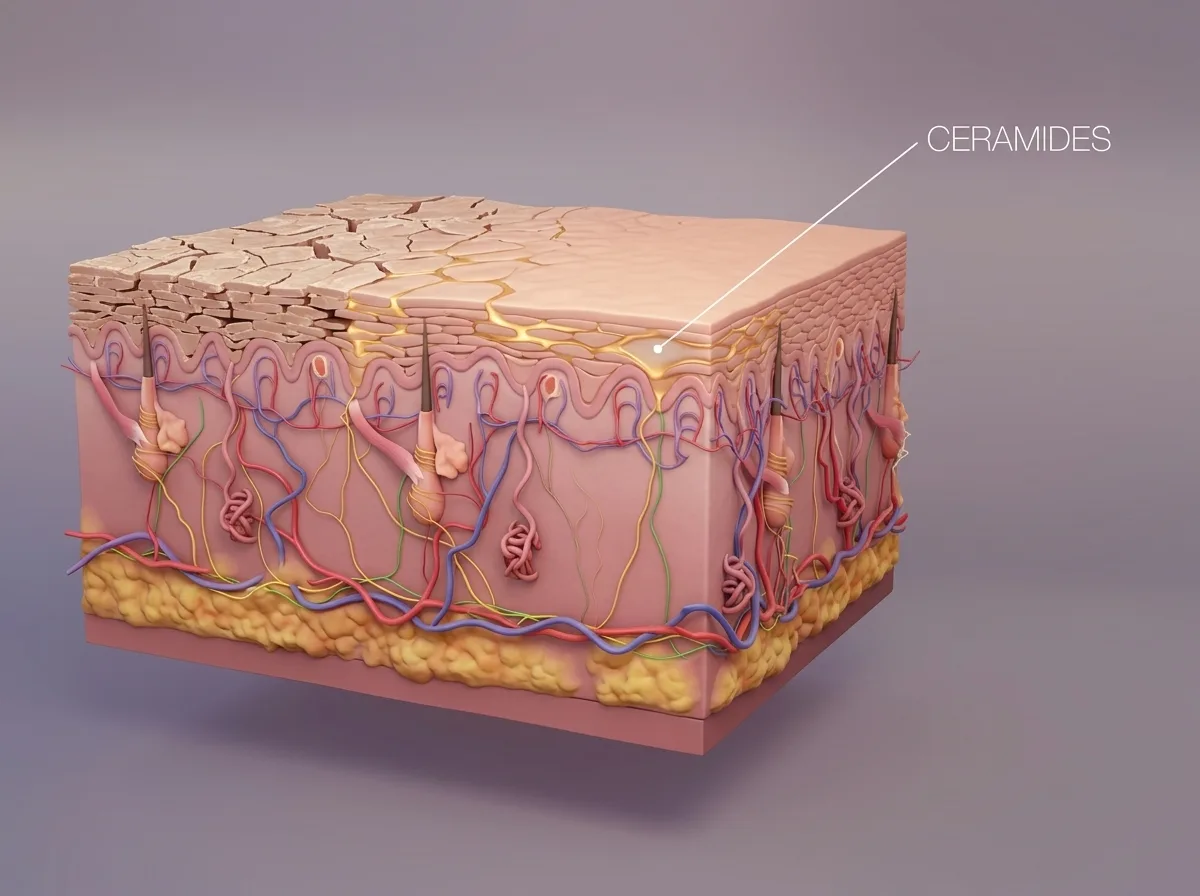
She said: ceramides, cholesterol and fatty acids, laid down in a structure between your skin cells, like mortar between bricks. That mortar is what keeps water in and keeps the world out. In eczema-prone skin it is thin from the start — there is a gene for it, filaggrin, and it runs in families.
When the mortar is thin, water walks out through the gaps, which is the dryness and the tightness and the cracking. And soap and dust and pollen and the enzymes in laundry detergent walk in through the same gaps, and your immune system does the only thing an immune system can do about a wall with holes in it. It inflames.
So the red patch is the last thing that happens. Not the first.
And then she said the sentence I have thought about every day since: if nothing you use ever puts mortar back, then every round of quiet is taken out of a wall that nobody is rebuilding.
Nothing on That Ladder Ever Contained a Single Gram of Mortar
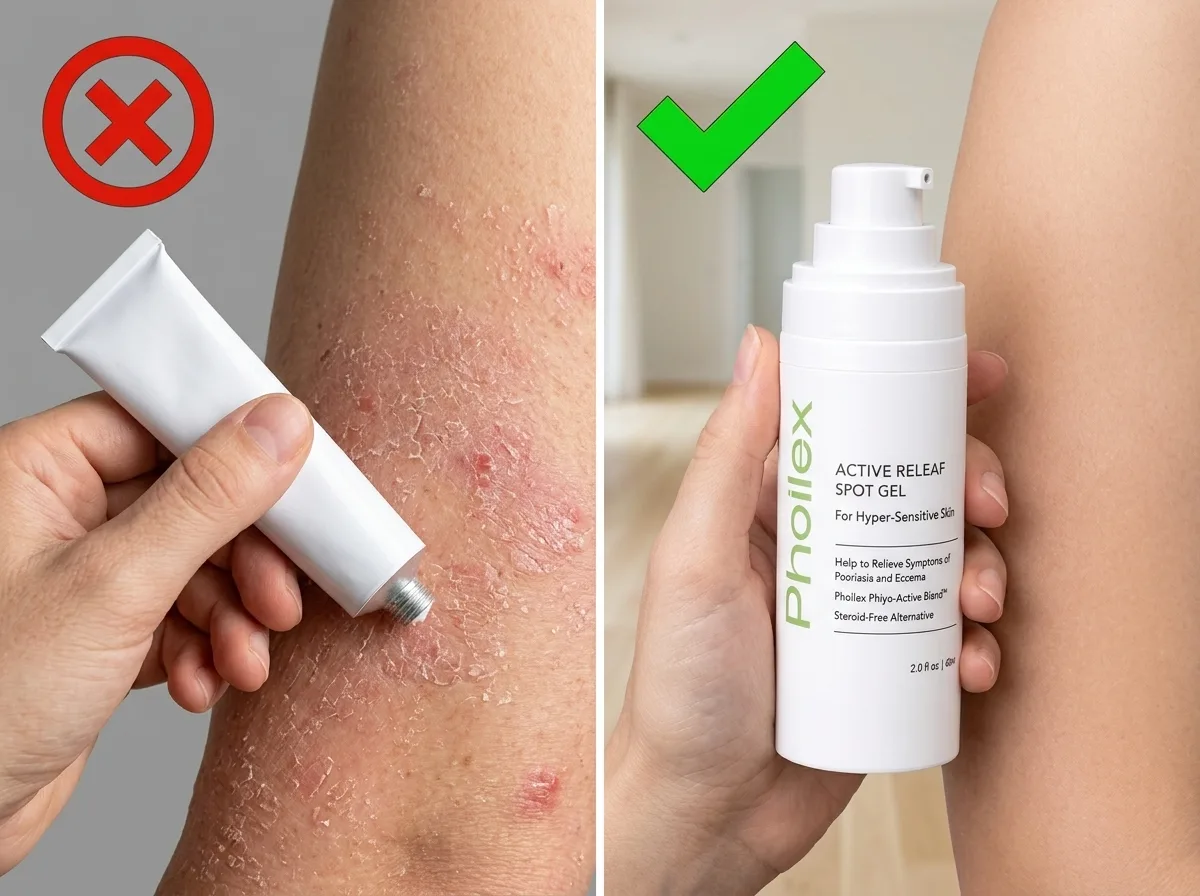
Go down the list with me. The steroids switch off the alarm. Elidel and Protopic are a different molecule doing the same job — the same switch with a different handle on it. Eucrisa quietens one enzyme in the chain. The petrolatum tub lays a tarpaulin. The elimination diet is trying to work out which brick the wind is coming through.
Which means the fade was never mysterious and it was never a bad batch. If the only thing on offer is borrowed quiet, then of course each loan is dearer than the last. That is what borrowing is.
I had spent nine years grading myself on a test where nobody had handed out the materials.
And If It Worked and You Stopped — That Is Not the Product Failing, and It Is Not You Either
I said there was a fourth thing that worked, and that I got that one wrong all by myself. Here it is, because I think a lot of people reading this have done the same and are quietly furious with a bottle that did nothing wrong.
Something works. Your skin goes quiet. It stays quiet for weeks, and quiet stops feeling like an achievement and starts feeling like the weather. So the bottle goes in the drawer, because why would you keep treating skin that is fine? And a while later you are back, and the obvious conclusion is that the stuff stopped working.
It didn’t. You stopped, and the calm was the thing you were maintaining. And before anyone feels stupid about that: every treatment any of us has ever been handed came with a taper, a break, a warning or a two-weeks-on rule. Nobody in this entire category has ever sold us maintenance. We were taught to treat and put down, and then blamed for putting down.
What Active ReLeaf Actually Is: a Steroid-Free Gel That Rebuilds the Wall Instead of Quietening It
I found Phoilex Active ReLeaf a few weeks after that conversation at the pharmacy counter, and I bought it for one reason: it was the first thing I had ever read about that was aimed at the wall instead of the smoke.
It is a steroid-free gel, forty-two dollars, dabbed on the spot rather than slathered everywhere.
It has a Triple Ceramide Complex — the mortar. The actual fats a filaggrin-faulty barrier is short of, put back where they are missing, so the wall is not thinner after this round than it was before it.
It has stabilised Vitamin D3, which works with the skin’s own immune cells to settle skin that has been on high alert for years. That matters here more than anywhere, because it is a different route to calm than cortisol. Nothing is borrowed, so there is nothing to pay back — and nothing to climb.
And it has colloidal oatmeal, Chinese skullcap and bisabolol, which take the itch and the redness down on contact, because a wall takes weeks to rebuild and nobody can be told to just endure it in the meantime.
I told my dermatologist I was adding it. I did not stop anything she had given me, and I am not telling you to stop anything either. I added the one thing that had never been in any of it.
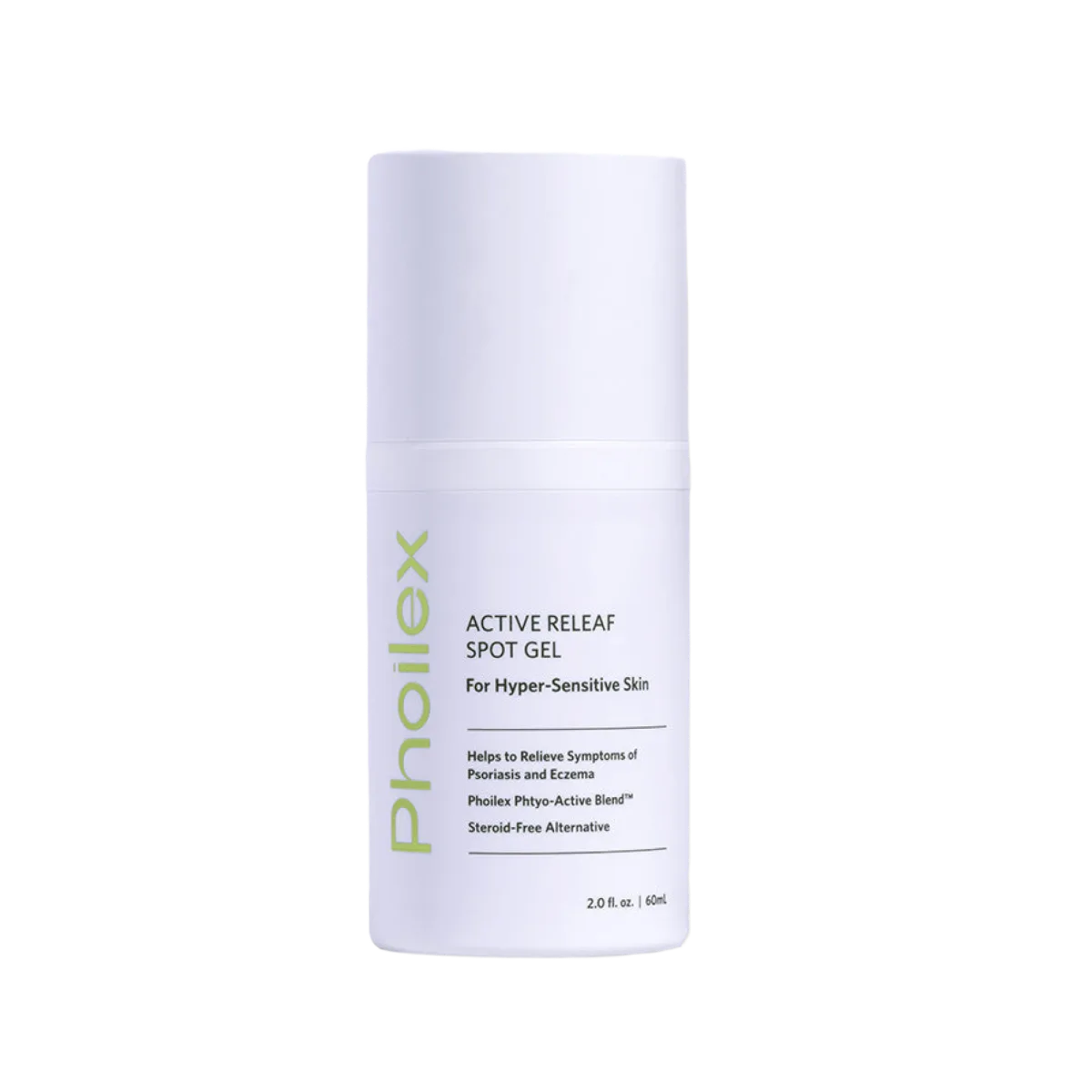
Phoilex Active ReLeaf Spot Gel
Steroid-free barrier-repair gel · 60 mL
- Triple Ceramide Complex — the ceramides, cholesterol and fatty acids the wall is actually built from, put back into it, so the thing underneath stops getting thinner every round
- Stabilised Vitamin D3 — settles skin that has been on high alert for years by working with your own immune cells rather than borrowing a steroid’s off-switch. Nothing borrowed means nothing to pay back — and nothing to climb
- Colloidal oatmeal, Chinese skullcap and bisabolol — take the itch and the redness down on contact, because a wall takes weeks to rebuild and nobody can be told to just put up with it until then
- Steroid-free, fragrance-free, and safe to use alongside everything your doctor has already given you
90-day money-back guarantee · free shipping over $75
The Itch Eased in the First Few Days. The Flares Spaced Out Around Week Eight.
The itch eased first. Not gone — eased, enough that I stopped waking at three in the morning already scratching.
The dryness let go over the first few weeks. The insides of my elbows stopped feeling like paper that had been folded too many times.
And the flares spaced out around week eight. That is the one I care about. I still have eczema-prone skin; I was born with it and the gene did not go anywhere. But I have not climbed to a stronger anything in over a year, and that sentence would have sounded like a fairy tale to me at thirty-two.
And I have not put it in the drawer. That is the whole of my technique. The calm is the thing I am maintaining.


Mine cleared up so well I stopped using it, and when it came back I assumed the gel had quit on me. It hadn’t. I’d quit on the wall while it was still being rebuilt. Went back on it and the ground came back.

Hydrocortisone, then triamcinolone, then clobetasol, in about four years. Nobody ever explained why it only went one way. This is the first thing I’ve used that hasn’t needed to be replaced by a stronger version of itself.

Everything I found worked brilliantly and then went flat on me, and I always assumed it was a bad batch. Then I did it to this one too — my skin went calm so I put it in the drawer, and of course I ended up back where I started. Nobody tells you the calm is the thing you are maintaining. Week eight again, and it is still doing what it did on week one.
Ninety Days to Find Out Whether You Were Ever Losing Ground at All

90 days to decide, not 90 seconds
Use it for a full twelve weeks. If your skin is no calmer than the day it arrived, write to us and we refund it — the tube can be empty. You risk the postage, nothing else.
It comes with a 90-day money-back guarantee, and I want to be honest about why that mattered to me specifically. It is not that I was worried about forty-two dollars. It is that I had been let down four times by things that worked first, and I did not have another disappointment in me.
Ninety days is long enough to get past week eight and find out which kind of person you are — the one who was losing ground to adaptation, or the one who was losing it to having stopped. If nothing changes, you send it back and you are out the postage.
So here is where you are.
You can go and get the next rung. I know exactly how that goes, because I did it three times, and each rung bought me less than the one before it and left me somewhere I could not walk back from.
Or you can put mortar into the wall for a few weeks and find out whether the ground was ever really lost.
Phoilex Active ReLeaf Spot Gel
Steroid-free barrier-repair gel · 60 mL
- Triple Ceramide Complex — the ceramides, cholesterol and fatty acids the wall is actually built from, put back into it, so the thing underneath stops getting thinner every round
- Stabilised Vitamin D3 — settles skin that has been on high alert for years by working with your own immune cells rather than borrowing a steroid’s off-switch. Nothing borrowed means nothing to pay back — and nothing to climb
- Colloidal oatmeal, Chinese skullcap and bisabolol — take the itch and the redness down on contact, because a wall takes weeks to rebuild and nobody can be told to just put up with it until then
- Steroid-free, fragrance-free, and safe to use alongside everything your doctor has already given you
90-day money-back guarantee · free shipping over $75
P.S. If you take one line from this, take the pharmacist’s: everything in your bathroom drawer either covers the wall or shouts at your immune system for noticing it. Go and look at the drawer. Then look at how much stronger each thing in it is than the one you bought before it.
P.P.S. To the person who is about to write a review saying it worked and then stopped — check first whether you stopped. I did that, and I very nearly blamed the only thing that was actually building something. Keep your dermatologist in the loop, keep whatever she has you on, and add the part that has never been in any of it.
As seen on